Each version's notes, kept as they were written. Start with the latest, or go back to the release you are running.
0.99.2 is out: the first public Linux release, substantially reworked Pinnacle, Sterling, Lancer, Obsidian and Scorch amps, and an overhauled Designer. Read the 0.99.2 notes. The Windows standalone awaits the signed Steinberg ASIO agreement. Check the packages and platform status.
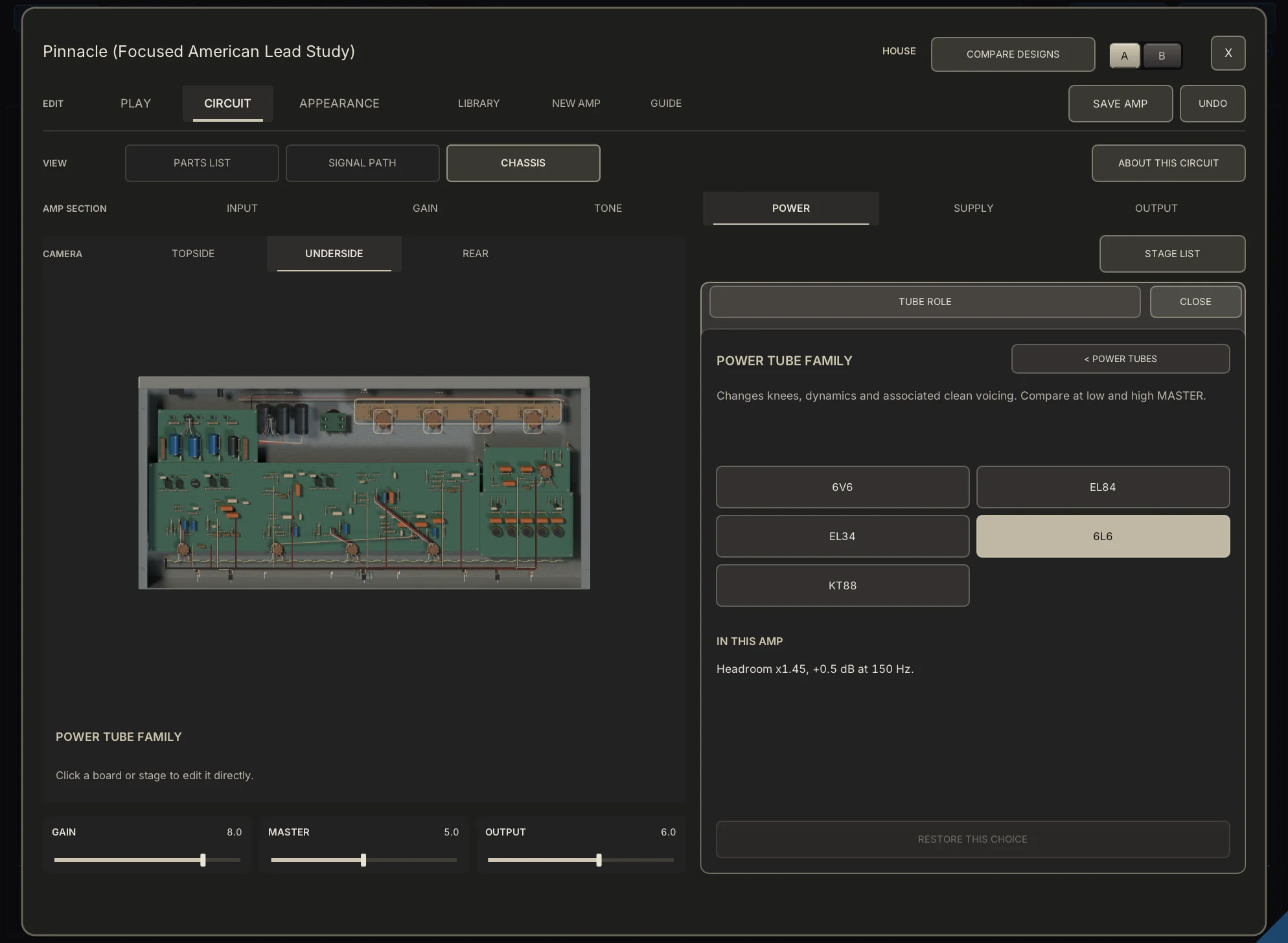
0.99.2 opens the amp on its chassis: click a tube to reach the stage behind it.
Latest
0.99.2: Linux, five reworked Artificer amps and the overhauled Designer
RigSculpt comes to Linux as VST3 and CLAP plug-ins, the standalone app and the Workshop. Pinnacle, Sterling, Lancer, Obsidian and Scorch have been rebuilt stage by stage around their circuit studies, with their earlier editions kept under LEGACY.
The Designer opens the amp on its chassis, explains each stage in SIGNAL PATH and lets you step real parts while you play. CAB STEREO and CAB LAYERS blend mics, send and return bring real pedals into the standalone rig, and MIDI profiles keep each controller's assignments. The two programs share the RigSculpt name.
0.99: build an amp, rearrange the rig and shape it with parametric EQ
Artificer amps are my own amp designs: eighteen house amps to open in the Designer, or NEW AMP to begin your own. FLEX arranges effects and parallel paths, and the eight-band parametric EQ shapes either amp or the whole rig. The 0.99.1 hotfix fixed the window size limit on laptops and a knob preview in the Designer.
0.98: rig snapshots, a looper, and gapless preset changes
Keep four rig snapshots in a preset, use the looper from footswitches, and change presets while delay and reverb tails continue. AFTERGLOW works in every delay mode, and Apple Silicon gains graphics-card processing.
0.97: AFTERGLOW pads, library discovery, and GPU processing
AFTERGLOW adds four pad voices, SWELL and STACK, with footswitch control. Browse NAMs with solo/hide controls, a pinned reference and more ways to ask for a different sound. Windows graphics-card processing and Workshop analysis expand too.
0.96: stereo multi-core, phase lanes, and clearer quality controls
Stereo Multi-Core and Phase Lanes share supported NAM processing across CPU cores. Quality settings are clearer, render oversampling offers more choices, and cabinet, pedal, reverb and preset browsing improve.
0.95: pedal NAM models, a MIDI preset bank, and the Workshop name
Play pedal NAMs, use a 32-slot MIDI preset bank, and shape the sound with revised NAM output EQ and cabinet cuts. RigSculpt Workshop becomes the analyzer's name, with pedal and full-rig analysis alongside amps, cabinets and reverbs.
Synergize gets changes for contrasting amps. Stereo pairs use measured level matching, library browsing gains keyboard controls, and saved rigs recall their second amp correctly.
RigSculpt reaches Intel and Apple Silicon Macs as VST3 and AU, with the analyzer on Apple Silicon. NAM Library Explorer makes auditioning quicker, with stereo matching and library improvements on both platforms.
0.92: the IN page, true stereo input, pickup revoicing, and MIDI
The IN page puts HUSH, NOISE FILTER and gate controls together. The update adds true stereo input, custom pickup revoicing, experimental DESCENT down-tuning, more MIDI control and steps for sending analyzed models to the plug-in.
These pages preserve the notes for each version, so older screenshots and control names may differ from today's interface. For current controls and practical steps, open the RigSculpt field guide.